

A national curriculum framework is required
“Most Vietnamese logistics companies consider employee training as an expense, not an investment. This perspective will not enhance competitiveness of the sector…” This is the opinion of Mr. Nguyen Duy Minh, General Secretary of Vietnam Logistics Business Association (VLA), at a talk about human resources training issues in the logistics sector.
“There is a high demand for a number of positions at logistics firms, while vocational schools are unable to train and provide competent and qualified graduates for these positions. Therefore, fierce competition in the recruitment process have been observed, in which logistics firms have poached staff from their competitors to reduce training expenses”- said Mr. Minh.
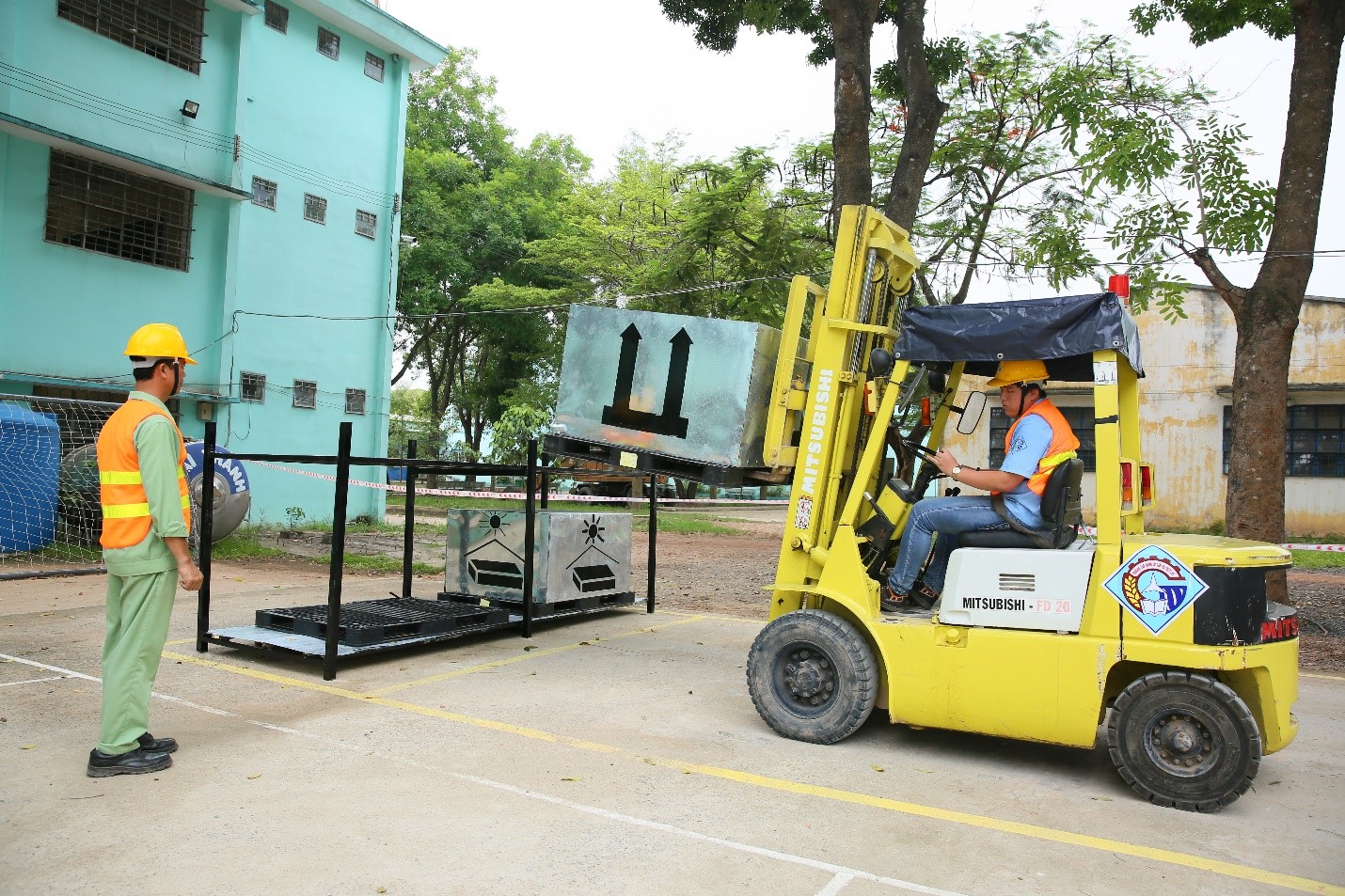
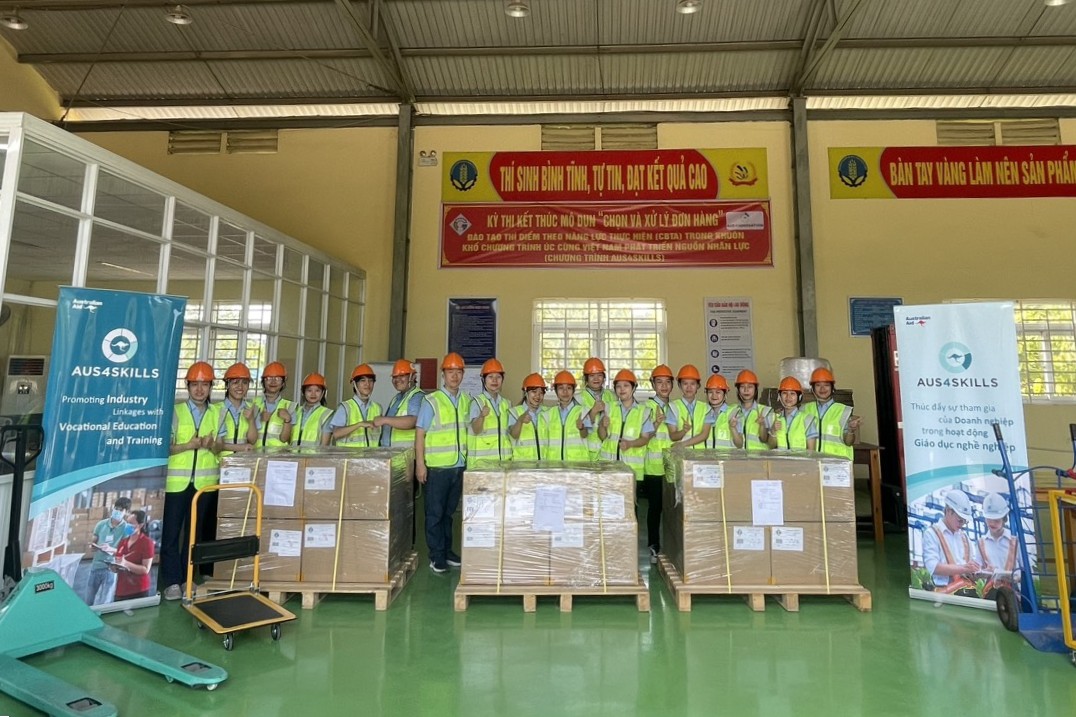
Students of Vocational College of Machinery and Irrigation in a forklift operator training class
Short-lived training scheme
Mr. Vu Ninh, Logistics Industry Reference Council (LIRC), which was established by the Aus4Skills Program, explained further: “With annual growth rate of approximately 16%, the logistics sector is always thirsty for human resources. For example, at Gemadept Corporation where Ninh is a member of the Board of Management at the corporation, there are 800 employees among whom more than 600 persons work at warehouses and ports. Therefore, the demand for logistics positions is high and new staff are recruited almost every year. In addition, it is critical to deliver vocational education and training (VET) which is comparable to other countries for promoting the sector’s development. In order to achieve this goal, a unified curriculum framework for the logistics sector should be developed, setting a common foundation for all VET schools to follow. We hope that Vietnamese human resources for the logistics sector will satisfy the demand in the next 5 years, reducing logistics expenses to 16% – 20% and enhancing the logistics companies’ competitiveness.”
Mr. Nguyen Van Lam, Deputy Director of Department of Labor, Invalids, and Social Affairs (DOLISA) Ho Chi Minh City, emphasized the necessity of a standardized curriculum for the logistics sectors: “For this typical sector, if each university established its own curriculum, learning outcomes will vary greatly and fail to meet workforce’s demand. At this stage, it is important to determine what theoretical knowledge and technologies are required. Based on this information, the curriculum should be developed in the context of the Fourth Industrial Revolution with a modern logistics system. On the other hand, each VET school can integrate other standards into the curriculum as long as their curriculum follows the national curriculum framework. Our direction in VET is that vocational programs shall allocate 40% of the course time for theory while the remaining 60% is spent in practical apprenticeship training at firms so that VET graduates will be able to work independently after recruitment. To realize this direction, stronger industry engagement in VET training in the logistics sector should be promoted, such as: companies should send their highly-skilled staff to VET schools to deliver training for students, etc.”
Tailor-made training programs
“Because a unified curriculum framework for the logistics sectors has not been provided, we conduct VET in accordance to requests from the logistics companies. For example, Tan Thanh Trading Mechanics Corporation requested to have 40 engineers and provided training materials to our college. We jointly developed a training program including 50% of the course time for theory and 50% for practice and work at the company. This flexible training model will provide a group of students who are qualified to meet specific requirements of a company. The more important feature is that these students had the opportunity to adapt to and practice at the company, allowing them to work right after graduation, reducing the gap between training at VET schools and enterprises.” – said Ms. Nguyen Thi Ly, Rector of Thu Duc College of Technology.
“VET activities should be led by enterprises to satisfy their requirements. Given this orientation, enterprise-based trainers should be dispatched to VET schools to deliver training and the logistics companies should provide students with internship opportunities during the course. In addition, a national curriculum framework for the logistics sector is required. For example, a Warehouse Operator should be able to control automatic warehouse systems, not just to load cargos.” – said Mr. Nguyen Van Chuong, Rector of Dong Nai Vocational College of Machinery and Irrigation (VCMI).
According to Mr. Vu Ninh, the Australian Government established the Logistics Industry Reference Committee and developed mechanisms to facilitate collaboration among VET facilities and enterprises, which are useful lessons for Vietnam. Currently, VLA has proposed the establishment of an Inter-Agency Logistics Coordination Committee to strengthen collaboration linkages and involving more and more enterprises.
“It is necessary to establish a Logistics Industry Advisory Council, with participation of employees. While the establishment of an Inter-Agency Logistics Coordination Committee is essential, our proposal to the Government is to upgrade the existing National Committee on Trade Facilitation to National Committee on Trade and Logistics Facilitation, rather than establishing a new committee. Currently, cooperation among stakeholders is limited, thus a coordinating agency is required to ensure its realization.” – said Mr. Nguyen Duy Minh, General Secretary of VLA.
According to some experts, Vietnam should develop a standardized vocational training framework for vocations in the logistics sector. These standards should be set and verified by the logistics enterprises as they will benefit from the training outcomes. In addition, linkages between theoretical training and practical work experiences should be promoted further. Logistics sector is a foundational sector which affects the growth of other sectors, such as: processing, manufacturing, etc.
Source: Vietnam Economic Times