

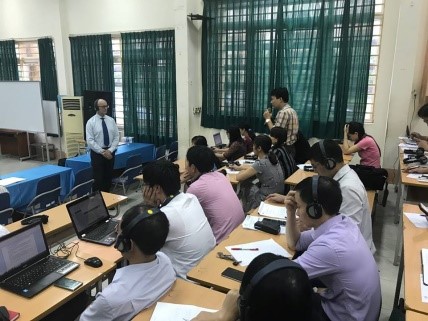
Dr Ralf Muhlberger attentively listening to university lecturers and staff in a discussion about university quality assurance
Education & Times Newspaper – This is advice from Dr Ralf Muhlberger – Education Expert, Queensland University of Technology, Australia to Vietnamese universities regarding quality assurance.
During his trip to Vietnam to advise and support Thai Nguyen University and Tay Bac University in quality accreditation, the Australian expert was interviewed by Education & Times Newspaper about university quality assurance in Vietnam and lessons learnt from Australian universities.
Vietnam applies the best university quality assurance standards
– Dear Dr Muhlberger, what do you think about quality assurance activities conducted by international and Vietnamese universities?
To satisfy the needs and expectations of students and demand of the labour market, universities in Europe, Australia, and the United States have established a quality assurance system by developing a set of quality assurance standards. These standards have changed significantly in the last few years. These quality assurance standards help universities grow better and bigger. On reaching a new development stage, these universities focus on improving and developing more appropriate standards.
As I know, the Ministry of Education and Training (MOET) has used the ASEAN University Network – Quality Assurance (AUN-QA). This is the most effective approach. This is advantageous to Vietnamese universities as they can learn and avoid mistakes made by international universities in the past. The quality assurance process requires substantial time and budget. If the Vietnamese authorities select a comprehensive, updated, and modern quality assurance system, it would be very helpful for the universities.
– From your viewpoint, what is the role of quality assurance in university autonomy?

Dr. Ralf Muhlberger
As Australian universities receive budgetary support from the Australian Government, they are accountable both to the Australian taxpayers and to students. The quality assurance system ensures consistent quality level across Australian universities so that students will not be disappointed with education services after being admitted to a university. Given the importance of consistent educational quality services, in the past the Australian Government supervised quality improvement and assurance in all universities. After some period of implementation, when the system operates smoothly, the Australian Government gradually limits its interventions and allows universities to conduct self-accreditation and submit reports to competent agencies.
The purpose of university autonomy is to allow universities to decide their educational services and outcomes which are required by students as well as the labour market. If a university’s processes and methods are compatible with quality assurance standards, the Government will not send inspectors to the university to inspect or supervise.
As I understand it, the Vietnamese higher education system has developed a quality assurance system along this direction. Previously, there were “hard limits” in curricula, but now universities can take initiatives in curricula development and can provide training programs which are necessary to students and labour market’s needs. In addition, Vietnamese universities conduct self-accreditation and quality assurance in accordance with regulations and standards set by MOET. At a specific development stage, MOET’s intervention and supervision will be reduced. The way Vietnamese universities are conducting quality assurance is similar to the Australian universities’ approach.
Selecting a difficult journey to catch up with international trends

Dr Ralf Muhlberger in discussion with lecturers and staff of Thai Nguyen University in a group activity
– Since you have been working at Thai Nguyen University to provide consulting and support for the implementation of application projects initiated by the Australia Awards Short Course in University Quality Assurance, how would you evaluate these projects?
University quality assurance requires three elements: a systematic and comprehensive approach; establishment of a quality assurance culture; and support of leaders at different levels. Through my discussion with leaders of Thai Nguyen University and its member universities, I witnessed strong support and enthusiasm for change in the management boards of all universities. This is a wonderful start for developing a quality assurance system.
The most difficult element in university quality assurance is the establishment of a quality assurance culture – how to make people understand that quality assurance or continuous development of the university is a shared responsibility. The previous approach in considering quality assurance was that it was someone’s duty, and that person would monitor and supervise the quality assurance process. This approach is no longer effective. Currently, universities involve all staff and lecturers in the quality assurance process.
The Australia Awards Short Course in University Quality Assurance has trained a group of capable officers who will implement quality assurance at their organizations. The course participants will share their newly gained knowledge and experiences with their colleagues to develop a sound quality assurance system. In this trip, I am very glad to have had the opportunity to talk with many lecturers and staff of Thai Nguyen University and its member universities. These discussions have established a common understanding about quality assurance and how to implement it across the Thai Nguyen University system and to contribute to changes in quality assurance culture.
When a university implements the quality assurance process, it will gradually become a world-class university. I think Thai Nguyen University and its member institutions have selected the right direction. This is a difficult journey, but we should start now in order to catch up with the development trends of the international tertiary education sector.
– You emphasized the necessity of raising awareness of university staff and lecturers in quality assurance implementation. It seems that the application projects of the course participants have exceeded your expectations. What is your opinion?
The leaders of Thai Nguyen University and its member universities studied in Australia and when they returned, they worked in three groups to develop three application projects adapting Australian quality assurance experience to Vietnam. These three projects target the three requirements of university quality assurance. In general, I think they are being implemented smoothly and effectively.
The reason we call it “application project” is that we would like participants to apply what they have learnt in Australia to Vietnam. We call it practice-based learning. Through their own thinking, application, and reflection, I believe that participants will determine differences between previous systems and current international practices.
After we shared and taught quality assurance implementation, how to apply it in the current situation in Vietnam is a big issue. Through implementation, we can see conflicts and difficulties which were not foreseen during the course. I am very proud to say that these universities have been successful. The success is not a quality assurance system – as this has not happened yet. They have succeeded in applying correctly what we shared and taught in Australia despite many difficulties in the application projects. I strongly believe that the universities will implement the next steps effectively after solving current conflicts. At that time, we, as Australian experts, can take a step back to observe and support them as necessary.
Let’s start with simple things
– Could you please give one piece of advice to Vietnamese university regarding quality assurance system?
In my opinion, let’s start with simple things. At first, we should review the current system and find out some possible improvements we can make promptly. An important element is that we should frequently update, transfer and gather data and information.
Under the previous system, universities would be accredited every 5 years to 7 years and each university would prepare many dossiers, documents and evidence to support the external evaluation of the government. This approach is passive since universities put almost all their efforts into collecting evidence and preparing documents and did not have time to make the necessary changes to improve educational quality.
The current system requires the integration of quality assurance into each activity, especially education and training activities. With support of information systems and equipment, teaching activities, parameters and data on the teaching process, etc. are recorded. We can find out and solve immediately difficulties that lecturers face in teaching activities. This process is called internal review, which is carried out regularly, helping us to identify the risks, problems and reduce the massive workload of information collection after 5-7 years.
To achieve comprehensive quality assurance, it is necessary to consider the needs and benefits of all stakeholders. The concept of quality assurance originated from enterprises – better quality brings higher revenue. However, in tertiary education, better quality is not necessarily higher revenue. In university quality assurance, we should continuously ask the following questions: Is the employment opportunity of graduates better? Does the company recruit our students because the university’s competitive advantage has improved? Does quality assurance create a better learning environment for current students? Through answering these questions and considering the benefits and needs of all stakeholders, we will have an overview about a university’s quality assurance system.
=======================================================================================
“Vietnamese universities have “latecomer advantages” in quality assurance, they can learn from experiences and mistakes of international higher educations and catch up quickly. However, it also comes with a disadvantage: while Australian universities change their process and correct each step gradually, Vietnamese universities are directly applying an advanced system. This would be a sudden and massive change in the university system.” said Dr Ralf Muhlberger
=======================================================================================
-Thank you very much for the discussion
Source: Translation of an article on Education and Times Newspaper